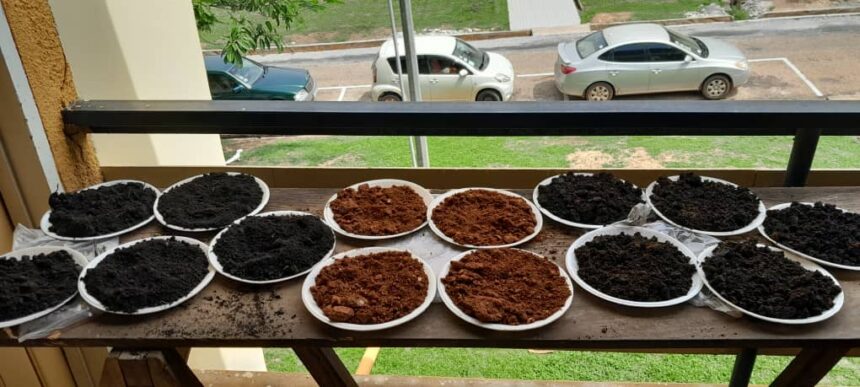
Indigenous carbon-rich dark soils in Ghana are facing a grave threat from heavy excavation, encroachment, and poor farming practices. These soils, which play a crucial role in sequestering high pyrogenic carbons, are slowly losing their carbon sink function, ecological integrity, and environmental benefits. Urgent action is needed to prevent further degradation of these valuable soils.
Farmers in Ghana are already feeling the impact of climate change, with shifting weather patterns leading to reduced crop yields for staple foods like maize, rice, millet, soybean, and sorghum. The recent prolonged dry spell in the country scorched nearly a million acres of farmland, leaving thousands of farmers without a harvest and stripping them of their livelihoods.
One such farmer, Alhassan Bukari, experienced a total crop failure on his 10-acre maize farm in the Bono East Region due to the extreme weather conditions. Like many other farmers, he had hoped to use the proceeds from his harvest to support his family and children’s education.
The soil on which Alhassan farms is one of the few types in Ghana known for its richness in carbon. These African Dark Earth (AfDE) soils are highly fertile, dark-colored, carbon-rich soils that have been studied extensively in Ghana and Liberia since the 1990s. Created through centuries of human settlement and agricultural practices, these soils are a valuable agricultural treasure for food security and climate mitigation.
However, AfDE soils are facing severe degradation from encroachment, nutrient mining, and poor farming practices. Encroachment by illegal mining activities and deforestation is threatening these valuable soils, while bad farming practices like slash and burn techniques are depleting soil carbon stocks and reducing fertility.
Soil scientist Emmanuel Baidoo from the Soil Research Institute of the Council for Scientific and Industrial Research (CSIR-SRI) is conducting research on AfDE soils and their potential for sustainable agriculture. He emphasizes the need for farmers to adopt best management practices such as balanced fertilizer application, composting, crop rotation, and biochar applications to maintain soil fertility and carbon storage.
Despite the challenges facing AfDE soils, research has shown that they have the potential to significantly increase crop yields compared to non-dark earths. Maize grown on AfDE soils without fertilizer application yielded twice as much as non-dark earths, highlighting the importance of preserving these soils for food security and climate resilience.
As Ghana grapples with soil degradation, food insecurity, and climate vulnerability, supporting indigenous practices like AfDE farming could empower smallholder farmers to contribute to the global carbon budget. By protecting and preserving these valuable soils, Ghana can harness nature-based solutions to mitigate climate change and ensure food security for future generations.